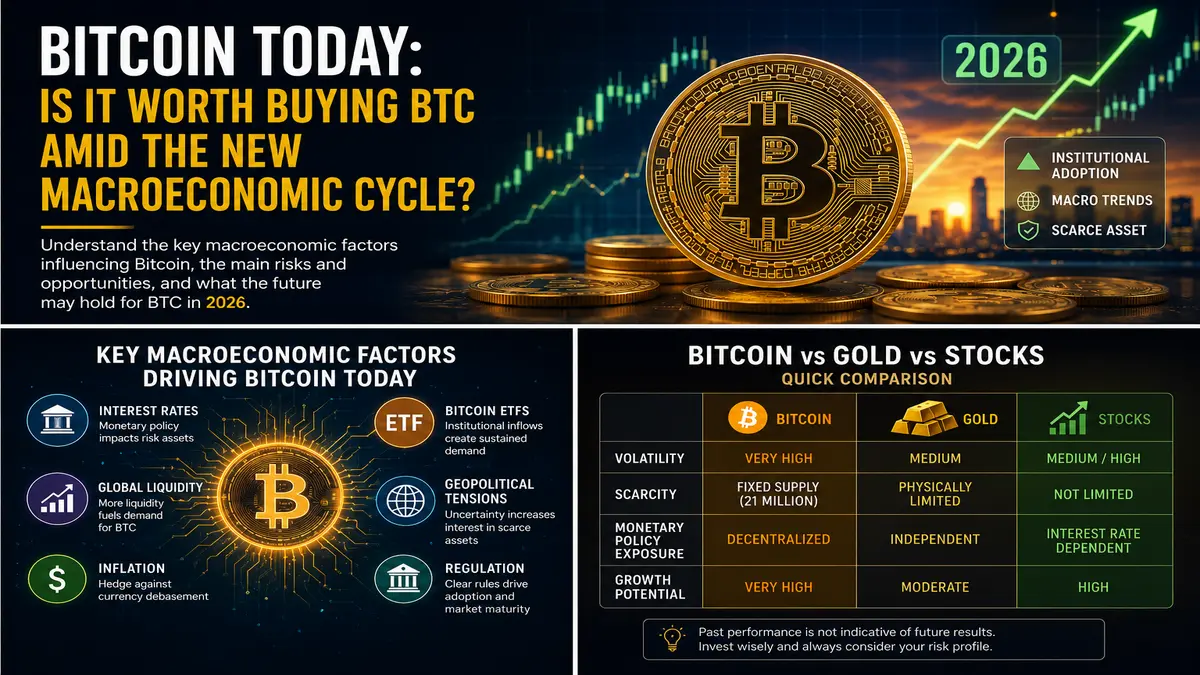
Bitcoin today remains one of the most closely watched assets in global markets because it combines digital scarcity, high volatility, and growing integration into the traditional financial system. In 2026, the decision to buy BTC depends less on hype and more on macroeconomic factors such as U.S. interest rates, global liquidity, ETFs, and monetary policy.
Bitcoin has returned to the center of the global financial debate. After the approval of spot ETFs in the United States, the expansion of institutional exposure to digital assets, and the growing discussion around de-dollarization, many investors are asking whether BTC still has room to grow — or whether the market has already priced in the new cycle.
That question is legitimate. According to data from CoinMarketCap, Bitcoin continues to rank among the world’s largest financial assets by market capitalization, frequently surpassing the US$1 trillion mark. At the same time, factors such as elevated U.S. interest rates, persistent inflation, and geopolitical tensions have increased uncertainty across global markets.
The current environment is different from previous crypto cycles. Today, banks, asset managers, and institutional funds participate directly in the crypto market. That changes liquidity, volatility, and even the narrative surrounding Bitcoin as a financial hedge.
In this article, you will understand:
- what is driving Bitcoin today;
- which macroeconomic factors influence BTC;
- the real risks behind the market;
- whether buying Bitcoin in 2026 still makes sense;
- and which scenarios could shape the coming years.
What Is Driving Bitcoin Today?
Bitcoin’s price today is influenced by a combination of macroeconomic, institutional, and geopolitical factors. Unlike the 2020–2021 cycle, the market now reacts heavily to global liquidity conditions and central bank decisions.
Among the main drivers behind BTC today are:
- Federal Reserve monetary policy;
- capital inflows through spot ETFs;
- global inflation;
- institutional adoption;
- cryptocurrency regulation;
- geopolitical tensions;
- weakening fiat currencies;
- rising global sovereign debt.
According to Federal Reserve Economic Data (FRED), U.S. interest rates remained elevated for longer following the inflation shock that began in 2022. This directly affected risk assets, including cryptocurrencies.
ETFs Changed the Bitcoin Market
The approval of spot Bitcoin ETFs in the United States created a new structural source of institutional demand.
Before ETFs, many funds could not buy BTC directly due to regulatory or operational restrictions. ETFs made Bitcoin exposure significantly easier for:
- pension funds;
- family offices;
- institutional investors;
- banks;
- major asset managers.
This shift helped reduce the perception that Bitcoin was merely a speculative retail asset.
Is Bitcoin Today Still Considered a Risky Investment?
Yes. Even with stronger institutional adoption, Bitcoin remains a highly volatile asset.
Price swings of 10% to 20% within days are still relatively common. This happens because the crypto market still has:
- lower liquidity than traditional markets;
- a strong speculative component;
- high sensitivity to macroeconomic conditions;
- influence from large holders (“whales”).
When analyzing Bitcoin today, it is important to separate two concepts:
- volatility risk;
- existential risk.
Volatility remains high. However, Bitcoin’s existential risk has declined significantly due to:
- ETF adoption;
- institutional participation;
- clearer regulations;
- publicly traded companies holding BTC exposure.
Bitcoin vs Gold vs Stocks
| Asset | Volatility | Scarcity | Monetary Policy Exposure | Growth Potential |
|---|---|---|---|---|
| Bitcoin | Very High | Fixed at 21 million | Decentralized | Very High |
| Gold | Medium | Physically limited | Independent | Moderate |
| Stocks | Medium/High | Not limited | Interest-rate dependent | High |
This comparison helps explain why many investors increasingly view Bitcoin as a form of “digital gold.”
According to BlackRock, alternative and uncorrelated assets have become more important during periods of global monetary uncertainty.
How Interest Rates and Inflation Affect Bitcoin Today
Bitcoin has a strong indirect correlation with global monetary liquidity.
When interest rates rise:
- government bonds become more attractive;
- investors reduce risk exposure;
- the U.S. dollar tends to strengthen;
- cryptocurrencies often face downward pressure.
When interest rates fall:
- appetite for risk increases;
- available liquidity expands;
- investors seek protection against currency debasement;
- scarce assets tend to benefit.
Inflation’s Role in BTC
For years, Bitcoin was marketed as an inflation hedge. In practice, the relationship is more complex.
In the short term, BTC behaves more like a risk asset than a defensive store of value.
Over the long term, however, many investors see Bitcoin as protection against:
- excessive money printing;
- currency devaluation;
- rising sovereign debt;
- declining purchasing power of fiat currencies.
According to data from the International Monetary Fund (IMF), global public debt reached historically elevated levels after pandemic-related economic stimulus measures.
This strengthened the narrative around scarce assets.
Is It Worth Buying Bitcoin Today?
The answer depends on an investor’s risk tolerance, time horizon, and financial objectives.
For those seeking predictable short-term returns, Bitcoin may not be suitable. For long-term investors, however, BTC continues to be viewed as a strategic bet on global monetary and financial transformation.
In practice, many investors use Bitcoin today for:
- portfolio diversification;
- partial protection against currency debasement;
- exposure to the digital economy;
- institutional adoption growth potential.
When Does BTC Tend to Perform Best?
Historically, Bitcoin tends to perform better when:
- interest rates begin to decline;
- global liquidity expands;
- the U.S. dollar weakens;
- monetary stimulus increases;
- institutional adoption accelerates.
The worst scenarios usually involve:
- aggressive monetary tightening;
- severe recessions;
- liquidity crises;
- coordinated regulatory crackdowns.
Common Bitcoin Investment Strategies
| Strategy | Characteristics | Investor Profile |
|---|---|---|
| Buy and Hold | Long-term ownership | Conservative within crypto |
| DCA (Dollar-Cost Averaging) | Regular purchases over time | Moderate |
| Trading | Short-term operations | Aggressive |
| Small Allocation | 1% to 5% portfolio exposure | Diversification-focused |
In practice, dollar-cost averaging (DCA) became popular because it reduces emotional decision-making caused by volatility.
Could the New Macroeconomic Cycle Benefit Bitcoin?
There is a growing thesis that the world is entering a new macroeconomic regime.
This environment includes:
- structurally high sovereign debt;
- geopolitical fragmentation;
- less predictable inflation;
- partial deglobalization;
- rivalry between major powers;
- questions surrounding U.S. dollar dominance.
All of this increases interest in assets considered:
- scarce;
- global;
- politically neutral;
- resistant to monetary expansion.
The Impact of De-Dollarization
BRICS nations and other emerging economies have increasingly discussed alternatives to the U.S. dollar in international trade.
Although the dollar remains dominant, this trend strengthens debates around:
- monetary sovereignty;
- neutral assets;
- parallel financial systems.
Bitcoin partially benefits from this narrative because it operates independently from direct central bank control.
According to the International Monetary Fund (IMF), changes to the international monetary system usually occur gradually, but periods of geopolitical tension tend to accelerate financial transformations.
Main Risks of Buying Bitcoin Today
Despite growing institutional adoption, the risks remain significant.
1. Extreme Volatility
BTC can still experience rapid declines exceeding 30%.
2. Regulation
Regulatory changes may affect:
- exchanges;
- taxation;
- custody services;
- market liquidity.
3. Technological Risk
Although the Bitcoin network has historically proven highly secure, technological risks can never be entirely ruled out.
4. Dependence on Global Liquidity
The crypto market remains highly dependent on international capital flows.
5. Emotional Investor Behavior
Many investors enter the market driven by FOMO (“fear of missing out”) and end up making impulsive decisions.
What Institutional Investors See in Bitcoin
Large institutions no longer view Bitcoin the same way retail traders did in previous cycles.
Today, many funds see BTC as:
- an alternative asset;
- a monetary hedge;
- an asymmetric opportunity;
- a scarce digital reserve asset.
Institutional participation has fundamentally changed market perception.
Companies increasingly consider:
- strategic BTC exposure;
- integration with financial products;
- institutional-grade custody;
- asset tokenization.
Is Bitcoin Becoming Mainstream?
Partially.
The crypto market is becoming increasingly integrated into the traditional financial system through:
- ETFs;
- banks;
- derivatives;
- institutional brokers;
- regulated funds.
This increases legitimacy, but it also ties Bitcoin more closely to global financial cycles.
To learn more about the topic, check out our latest blog post: Bitcoin Regulation in 2026: How Global Frameworks Are Reshaping the Crypto Market
Conclusion
The debate over whether to buy Bitcoin today goes far beyond BTC’s price action. The asset has become part of broader discussions surrounding inflation, sovereign debt, monetary policy, de-dollarization, and the transformation of the global financial system.
Bitcoin remains a volatile and high-risk asset. However, it has also established itself as an asset class monitored by governments, banks, hedge funds, and institutional investors worldwide.
For investors with a long-term perspective who understand the risks involved, BTC may serve as a strategic diversification tool. For those seeking predictability or low volatility, the crypto market may not be the ideal environment.
The macroeconomic environment over the coming years will likely remain the primary driver behind Bitcoin’s performance. Understanding that broader context is becoming increasingly essential for interpreting market behavior.
Important Disclaimer
The information presented here is for educational and informational purposes only and does not constitute investment advice. Consult a certified financial professional before making financial decisions.
FAQ — Bitcoin Today
Can Bitcoin still rise significantly?
Yes. Many analysts believe Bitcoin still has substantial upside potential due to scarcity, institutional adoption, and the growth of digital financial infrastructure. However, it remains highly volatile.
Is Bitcoin a safe investment?
Bitcoin operates on a historically secure decentralized network. Nevertheless, investing in BTC involves considerable risks related to volatility, regulation, and financial losses.
Is buying Bitcoin gradually a good strategy?
Dollar-cost averaging (DCA) is widely used to reduce the impact of volatility. It involves investing fixed amounts regularly over time instead of trying to time the market.
What influences Bitcoin’s price the most today?
Key drivers include U.S. interest rates, global liquidity, spot Bitcoin ETFs, institutional adoption, regulation, and international macroeconomic conditions.
Could Bitcoin replace the U.S. dollar?
That remains unlikely in the short term. The U.S. dollar continues to dominate global reserves and international trade. However, Bitcoin increasingly participates in discussions around alternative monetary systems and scarce digital assets.
Is Bitcoin comparable to gold?
Many investors refer to BTC as “digital gold” because of its limited supply. The major difference is that Bitcoin remains significantly more volatile than gold.
Does halving still influence Bitcoin today?
Yes. Bitcoin halving events reduce the issuance of new BTC and historically affected supply-demand cycles. However, macroeconomic conditions now play a much larger role as well.

About Financial Cryptarch
Financial Cryptarch is the Founder of Criptocurrencie and a finance professional with over 15 years of experience in Accounting and Corporate Finance. Holding a Bachelor’s Degree in Accounting and an MBA in Corporate Finance, he focuses on cryptocurrencies, macroeconomics, global finance, and international geopolitics, helping readers understand the forces shaping money, markets, and economic power.