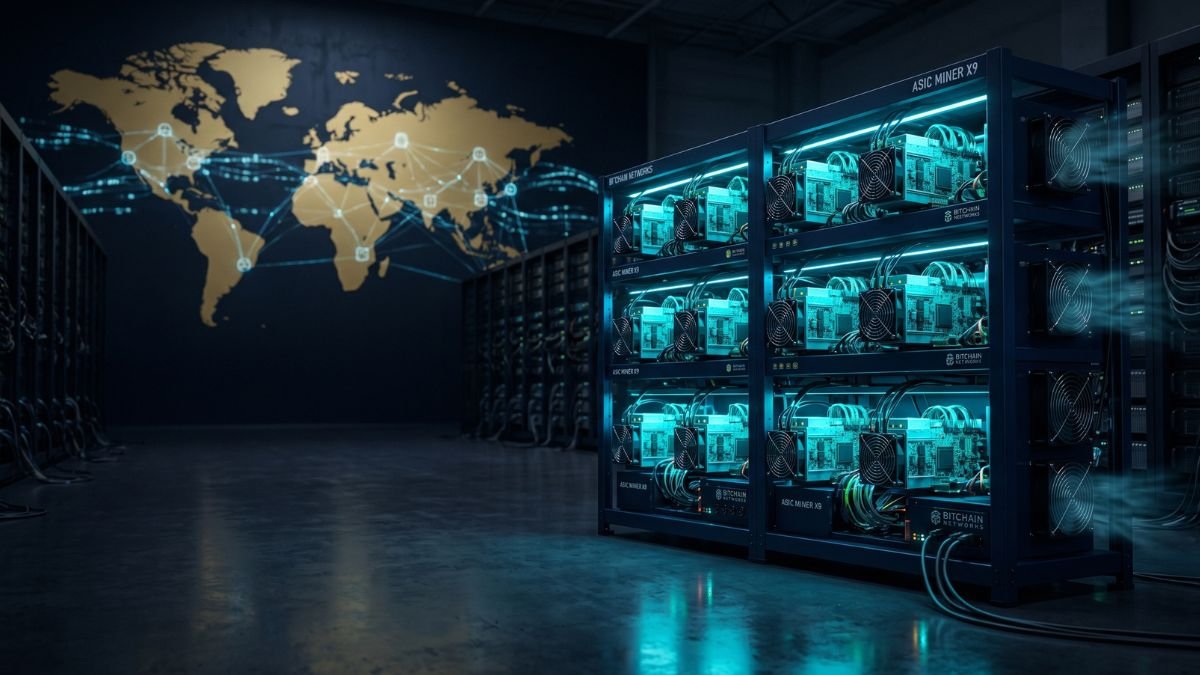
Bitcoin mining is the process by which new bitcoins are created and transactions on the Bitcoin network are verified and recorded. Miners use specialized hardware to solve complex mathematical puzzles, securing the blockchain in exchange for block rewards — currently 3.125 BTC per block after the 2024 halving.
Introduction
Bitcoin mining sits at the heart of the world’s most valuable cryptocurrency network. Whether you’re a curious investor, a finance enthusiast, or someone considering entering the mining space, understanding how Bitcoin mining works is essential before committing capital or energy resources.
The concept is straightforward in theory: miners compete to validate transaction blocks and earn Bitcoin as a reward. In practice, however, the mechanics involve significant hardware investment, energy consumption, and a constantly shifting competitive landscape. According to the Cambridge Centre for Alternative Finance, Bitcoin’s annualized electricity consumption rivals that of entire nations, underscoring both the scale and seriousness of the mining industry.
This guide breaks down exactly what Bitcoin mining is, how long it takes to mine one Bitcoin, whether mining is profitable in 2025, and its legal status in the United States.
What Actually Is Bitcoin Mining?
Bitcoin mining is the computational process that maintains the integrity of the Bitcoin blockchain. It is the mechanism through which new bitcoins enter circulation and unconfirmed transactions are bundled into verified blocks.
At a technical level, miners run specialized hardware — known as ASICs (Application-Specific Integrated Circuits) — to repeatedly hash transaction data combined with a random number called a “nonce.” The goal is to produce a hash output that falls below a network-defined target value. This is the core of Bitcoin’s Proof-of-Work (PoW) consensus mechanism.
When a miner finds a valid hash, the new block is broadcast to the network, other nodes verify its correctness, and the miner receives the block reward plus all transaction fees included in that block. This process repeats approximately every 10 minutes, controlled by a difficulty adjustment algorithm that recalibrates every 2,016 blocks (roughly two weeks).
Key components of Bitcoin mining:
- ASIC miners — purpose-built chips optimized for SHA-256 hashing (e.g., Antminer S21 Pro, Whatsminer M60S)
- Mining pool — a collective of miners sharing computational resources and splitting rewards proportionally
- Hash rate — the total computational power contributed by a miner or the entire network
- Difficulty adjustment — the network’s self-regulating mechanism to keep block times near 10 minutes
The Bitcoin network’s total hash rate surpassed 700 exahashes per second (EH/s) in late 2024, reflecting record levels of mining competition globally.
How Long Will It Take to Mine 1 Bitcoin?
Solo mining one full Bitcoin is, for most individuals, a near-impossibility. Here is why.
The Bitcoin network produces 3.125 BTC per block (post-April 2024 halving), and one block is mined roughly every 10 minutes. That means approximately 450 BTC are mined daily across the entire network.
To solo mine one Bitcoin, your hardware must solve a block before every other miner on the network. With a network hash rate above 700 EH/s and a consumer-grade ASIC generating perhaps 200–400 TH/s, your probability of finding a block in any given 10-minute window is astronomically low.
Estimated time to mine 1 BTC — solo mining:
| Hardware | Hash Rate | Estimated Time to Mine 1 BTC (Solo) |
|---|---|---|
| Antminer S21 Pro | 234 TH/s | ~2,000–5,000 years |
| Whatsminer M60S | 186 TH/s | ~3,000–7,000 years |
| High-end mining farm (100 units) | 23,400 TH/s | ~20–50 years |
Through a mining pool, the math changes dramatically. Your earnings are proportional to the hash rate you contribute to the pool’s total. A miner running a single Antminer S21 Pro might realistically earn a fraction of a BTC per month, potentially accumulating 1 full BTC over a period of years — depending entirely on Bitcoin’s price, network difficulty, and operational costs.
The takeaway: there is no fixed answer to how long it takes to mine 1 Bitcoin because it depends on your hardware, your pool share, network difficulty, and luck. What is certain is that solo mining one full coin is not a realistic goal for individual miners.
Does Bitcoin Mining Actually Pay?
Bitcoin mining can be profitable, but profitability is not guaranteed and fluctuates significantly based on several variables.
The core profitability equation:
Mining Revenue = (Miner Hash Rate / Network Hash Rate) × Daily BTC Issued × BTC Price
Against this revenue, miners must subtract:
- Electricity costs (the dominant variable expense)
- Hardware depreciation (ASIC lifespan is typically 3–5 years)
- Cooling and facility overhead
- Pool fees (usually 1–2%)
As of mid-2025, the average all-in cash cost to mine one Bitcoin for publicly listed miners was estimated between $25,000 and $45,000, depending on energy rates and hardware efficiency. Miners with access to sub-$0.04/kWh electricity in regions like Texas, Kazakhstan, or Paraguay maintain meaningful margins when Bitcoin trades above $60,000.
Factors that determine mining profitability:
- Electricity rate — the single most important cost driver
- Hardware efficiency — measured in joules per terahash (J/TH); lower is better
- Bitcoin price — directly drives revenue per block
- Network difficulty — as more miners join, individual rewards shrink
- Halving cycles — the 2024 halving cut block rewards from 6.25 to 3.125 BTC, compressing margins industry-wide
A useful tool for real-time profitability calculation is CoinWarz’s Bitcoin Mining Calculator, which factors in hash rate, power consumption, electricity cost, and pool fees.
For retail-scale miners operating at household electricity rates ($0.10–$0.15/kWh), mining is generally not profitable on a pure cost basis in 2025. However, some miners treat it as a long-term Bitcoin accumulation strategy, accepting short-term losses in anticipation of price appreciation.
Can You Legally Mine Bitcoin in the United States?
Yes, Bitcoin mining is legal in the United States at the federal level. There are no federal laws prohibiting individuals or businesses from mining Bitcoin. However, the regulatory landscape is complex and evolving.
Federal considerations:
- The IRS treats mined Bitcoin as taxable income at fair market value on the date of receipt. Miners must report this income and pay taxes accordingly. IRS Notice 2014-21 and subsequent guidance formalized this treatment.
- The SEC and CFTC have debated regulatory jurisdiction over cryptocurrency, but neither agency restricts mining activity itself.
State-level variation:
The legal and business environment for mining varies significantly by state:
- Texas and Wyoming have positioned themselves as crypto-friendly states, offering favorable energy markets and light-touch regulation.
- New York enacted a two-year moratorium on new proof-of-work mining permits in 2022, citing environmental concerns. That moratorium expired in 2024, but new environmental review requirements remain in place.
- Kentucky and Montana offer tax incentives for mining operations.
Key legal obligations for US miners:
- Report mining income to the IRS
- Register as a business if operating at commercial scale
- Comply with state-level licensing, zoning, and environmental regulations
- Obtain proper electrical permits for large installations
Mining is legal, but operating compliantly requires understanding both federal tax obligations and your specific state’s regulatory framework.
The Environmental Debate Around Bitcoin Mining
Bitcoin mining’s energy consumption is a recurring point of contention. Critics argue the network’s energy use is disproportionate relative to its utility; proponents counter that an increasing share of mining now runs on renewable energy.
According to the Bitcoin Mining Council’s Q4 2024 report, participating mining companies — representing over 50% of global hash rate — reported a sustainable electricity mix of approximately 53%. This figure is contested by independent researchers, but the trend toward renewables, driven primarily by cost incentives rather than environmental mandates, is broadly accepted.
Mining operations increasingly co-locate near hydroelectric, wind, and solar installations. Some operators argue that mining can act as a flexible energy load, absorbing excess generation that would otherwise be curtailed, effectively monetizing stranded or surplus electricity.
The environmental calculus is complex, and reasonable people disagree on net impact. What is measurable is that energy efficiency in mining hardware improves with each hardware generation, and competitive pressure pushes miners toward the cheapest — increasingly renewable — electricity sources.
Conclusion
Bitcoin mining is a legitimate, technically demanding, and capital-intensive industry. For large-scale operators with access to cheap energy and efficient hardware, it remains a viable business. For individual retail miners, the economics are challenging in 2025, particularly after the April 2024 halving reduced block rewards to 3.125 BTC.
Understanding the fundamentals — what mining is, how long it realistically takes to accumulate Bitcoin through mining, what drives profitability, and how US law treats the activity — equips you to evaluate whether mining aligns with your financial goals. As always, research your specific energy costs and local regulations before making any investment in mining hardware.
Important Disclaimer
This article is for informational and educational purposes only. It does not constitute financial, investment, or legal advice. Bitcoin mining involves substantial financial risk, including hardware depreciation and volatile cryptocurrency prices. Consult a qualified financial advisor and tax professional before making any mining-related investment decisions.
FAQ — Bitcoin Mining
What is Bitcoin mining in simple terms? Bitcoin mining is the process of using specialized computers to verify Bitcoin transactions and add them to the blockchain. Miners are rewarded with newly created bitcoins for this work, which also secures the network against fraud.
How long does it take to mine 1 Bitcoin? There is no fixed timeframe. Alone, a single ASIC miner could theoretically take thousands of years to mine one full Bitcoin. Through a mining pool, a miner might accumulate 1 BTC over months or years depending on hardware power, pool size, and network difficulty.
Is Bitcoin mining profitable in 2025? Profitability depends on electricity costs, hardware efficiency, and Bitcoin’s market price. Miners with access to electricity below $0.05/kWh and modern hardware can operate profitably. Those at standard residential rates typically cannot cover costs without significant Bitcoin price appreciation.
Is Bitcoin mining legal in the US? Yes. Bitcoin mining is legal at the federal level in the United States. Miners must report income to the IRS, and some states impose additional environmental or licensing requirements. New York has the most restrictive state-level regulations as of 2025.
What hardware do you need to mine Bitcoin? Modern Bitcoin mining requires an ASIC (Application-Specific Integrated Circuit) miner, such as the Bitmain Antminer S21 Pro or MicroBT Whatsminer M60S. GPUs are no longer competitive for Bitcoin’s SHA-256 algorithm.
What happens when all 21 million Bitcoins are mined? Once the 21 million BTC supply cap is reached (estimated around 2140), miners will no longer receive block subsidies. They will instead be compensated entirely through transaction fees, which are expected to increase as Bitcoin adoption grows.

About Financial Cryptarch
Financial Cryptarch is the Founder of Criptocurrencie and a finance professional with over 15 years of experience in Accounting and Corporate Finance. Holding a Bachelor’s Degree in Accounting and an MBA in Corporate Finance, he focuses on cryptocurrencies, macroeconomics, global finance, and international geopolitics, helping readers understand the forces shaping money, markets, and economic power.